You use language effortlessly every day, and rarely stop to think it over. Because why would you think over, that which you use to think over? - Okay, that was an instance of what I call gratuitous complexity - just being difficult for he sake of it.
Many of the more difficult sentences are the ones we call aphorisms. German philosophers have been experts at this. Take Nietzsche for example: "He who has a why to live can bear almost any how". A sentence which reveals a remarkable command of language.
But it isn't the language per se which he is in command of, well, that too - but more importantly it is the knowledge of what language is, and what it does. He peered deep into the words, and sucked out the marrow of the word "why" and "how". He has found their true meaning, and through this he has found a new place for them, in a new sentence, giving us a new sense of new meaning.
It is not easy to look into words this way. Imagine that word is a seed. The coat of the seed, is what it look like. The kernel of the seed is the meaning. To get to the meaning, you have to remove the coat.
I'll show you how. Think of a word like "man". When you read the word "man", you think of a man - not the word "man". So that if I say the words, "chap", "male", "dude" or "fellow", what do you really think of then? Then answer is, most likely, you think of a man. The man in your mind is the kernel of truth behind the veil of the words. When you need to know the true meaning, separated from the empty shell of words - if you need to, to do some serious thinking - then you can find all the synonyms and see what your imagination reveals to you that lies behind.
There is another technique - one that you might find easier. And that is by way of a simple definition. The words "definition" comes from the fifteenth century - and it meant to mark off the boundaries. When you define something, you give a synonym of many words - and you draw a ring around them and say "This is the complete meaning".
There is an advantage to definition. Then you can see into the kernel and figure out what it's made of. Take this definition of man from Webster's dictionary. "An adult male of the human kind: distinguished from woman, boy and youth." From this we get the information, that a man is an adult, and a human.
To know what something is, is also to know what it is not. The Webster's entry makes this perfectly clear - "A man is distinguished from boy". And were you to try your hand at finding out what peace really is - than I think you'd find that most other people have thought of it as the absence of war.
It is one thing to see behind the word "man", and quite another to find the meaning of "peace". Peace is so abstract, so removed from our everyday experience. Many of these things far removed are harder to peer through, because they themselves rest only on words. But in any case, in most thing we can dig fairly quickly down to our experience itself.
Shakespeare put into the mouth of Juliet: "What's in a name? That which we call a rose by any other name would smell as sweet." Which shows that, the experience helps us know, in the ende, what truly is - and what isn't.
There is a wealth of knowledge and perspectives here which I have not covered, but I think this is enough for a start. - The full breadth of this whole field of inquiry has filled thousands of books through millennia, and does not compact to the form of a blogpost. If you wish to enquire more - then I recommend reading about Aristotle's Categories, and then moving on to the original work.
Poem: Sometimes I like my words to be free
Sometimes I like my words to be free,
not burdened as beams in a tower -
not drowned as droplets in a stream,
not fettered as fido before the feast of his dreams.
Sometimes I like my words to leap,
Like children meeting the first winter snow,
or the suns rays on a tempting puddle.
I let them repeat themselves over and over.
And mingle with bad grammar.
n' End before sentences. Drool, slobber, spit and spew -
spin poetics on morning dew.
Just work, and have leisure.
That's my message of words to you.
not burdened as beams in a tower -
not drowned as droplets in a stream,
not fettered as fido before the feast of his dreams.
Sometimes I like my words to leap,
Like children meeting the first winter snow,
or the suns rays on a tempting puddle.
I let them repeat themselves over and over.
And mingle with bad grammar.
n' End before sentences. Drool, slobber, spit and spew -
spin poetics on morning dew.
Just work, and have leisure.
That's my message of words to you.

Poem: Don't get scared of those fancy words.
Don't get scared of those fancy words.
They paint masks for simple thoughts
some clever fool wants hidden
for shame we'd know he played us.
Don't fear those clever lines,
which give you truth so sharply
that it punctures common sense.
Behind lies lies, which would be
plain, if bored men
didn't vainly jumble words.
Don't you worry over big books,
You can't read the lot in one feel swoop -
only line after line, with words words words,
and chaptered at that.
They paint masks for simple thoughts
some clever fool wants hidden
for shame we'd know he played us.
Don't fear those clever lines,
which give you truth so sharply
that it punctures common sense.
Behind lies lies, which would be
plain, if bored men
didn't vainly jumble words.
Don't you worry over big books,
You can't read the lot in one feel swoop -
only line after line, with words words words,
and chaptered at that.
Why learn rational thinking?
I am currently in the process of writing a book about rational thinking. Today I was talking to a friend who, like me, likes to explore our wondrous world. After he had taught me about the number e, we headed down to the kitchen - and I introduced him to the theme of my book. He read the first outline of the first chapter. I explained some of the ideas. He sort of got it, and we spent some time exploring some simple ideas with the tool introduced in the first chapter. But then he asked me: What can I use this for?
It took a moment for me to realize that this wasn't totally obvious, and that one might have to explain this. It is an oft forgotten fact that what one does not know, one has no appreciation of not knowing. While rational thinking is highly requested in students of all ages, it is seldom, if ever, thought. Explaining how to think is often an abstract affair, and educators seem to shy away from the abstract. To make something abstract seems to somehow make it "less real". But I'm afraid it isn't nearly that simple.
The abstract categories are those with the biggest scope. Their properties are elegantly encompassed in the expression "to fathom". When your ideas can reach into the depths of your mind, you have command over it from shoal to shore, from surf to sand. You may learn these by comparing many concrete examples, but it is the abstraction of the shared ideas which make you connect them in a clear manner.
Clear thinking is also a word often used but seldom taught. By it we seem to mean an ability to discriminate between different ideas. This realisation is counterintuitive but powerful: Discrimination is a mode of definition. To say what something is not, is to, in the same stroke, tell what it is. A simple example is the mother asking her son if his sister drew that nice train on the wall. The admission that she didn't implicates that it was he.
Already we are beginning to see the uses of some training in rational thought. The ability to think with speed and clarity. Or in short - to be clever. Students of the social sciences, (also for some reason called the soft- sciences), are often blamed for being inept at mathematics - and thus useless in any "serious" work. It is sadly under-communicated that social scientist are the quickest to adopt, use and teach the more complicated and interesting concepts. This skill is as invisible to the layman as mathematics - but also under the additional concealment of the use of an everyday language. (Those who have suffered the weight of reading an overly pretentious social scientist know what harm the diminished feeling of self-worth in a subject such as anthropology can do.)
Oh well - I can see you yearn for concrete examples. So I will provide you with a list.
It took a moment for me to realize that this wasn't totally obvious, and that one might have to explain this. It is an oft forgotten fact that what one does not know, one has no appreciation of not knowing. While rational thinking is highly requested in students of all ages, it is seldom, if ever, thought. Explaining how to think is often an abstract affair, and educators seem to shy away from the abstract. To make something abstract seems to somehow make it "less real". But I'm afraid it isn't nearly that simple.
The abstract categories are those with the biggest scope. Their properties are elegantly encompassed in the expression "to fathom". When your ideas can reach into the depths of your mind, you have command over it from shoal to shore, from surf to sand. You may learn these by comparing many concrete examples, but it is the abstraction of the shared ideas which make you connect them in a clear manner.
Clear thinking is also a word often used but seldom taught. By it we seem to mean an ability to discriminate between different ideas. This realisation is counterintuitive but powerful: Discrimination is a mode of definition. To say what something is not, is to, in the same stroke, tell what it is. A simple example is the mother asking her son if his sister drew that nice train on the wall. The admission that she didn't implicates that it was he.
Already we are beginning to see the uses of some training in rational thought. The ability to think with speed and clarity. Or in short - to be clever. Students of the social sciences, (also for some reason called the soft- sciences), are often blamed for being inept at mathematics - and thus useless in any "serious" work. It is sadly under-communicated that social scientist are the quickest to adopt, use and teach the more complicated and interesting concepts. This skill is as invisible to the layman as mathematics - but also under the additional concealment of the use of an everyday language. (Those who have suffered the weight of reading an overly pretentious social scientist know what harm the diminished feeling of self-worth in a subject such as anthropology can do.)
Oh well - I can see you yearn for concrete examples. So I will provide you with a list.
- To protect yourself from the effects of political jargon.
- To form informed opinions of subjective matters, such as justice and love.
- To analyse your own fears and sorrows, and thus often dispel them.
- To increase your rate of learning.
- To better understand the fine-arts - increasing your appreciation.
- To write better.
- To find out and sort what matters to you in life, and what matters to society.
Rational thinking is the key to opening up all other intellectual fields - and that is why you should learn it. It is the honing of the sword of truth, the buffing of the spectacles of appreciation and the sowing of the seed of good humour.
A word of warning to the wise. Thinking is not something you just do when you see the problem, it is a habit - which by the learned is called meditation. Good luck to you in your intellectual pursuits.
Emil's Six Suggestions for Moral Conduct
One of my personal mottoes is: "Try not to let your ideals get in the way of your morals." My views on what is moral change over time, but they seem to revolve around these themes. And should you have any comments or suggestions I am more than happy to review and revise.
1: Try to know the difference between doing good and doing bad. Try to do good.
2: Try to know the difference between truthfullness and deceitfullness. Try to be truthfull.
3: Try to find out what is valuable, and what isn't. Cherish that which is valuable.
4: Respect the personal integrety of others. The different kinds are; of feelings, of opinion, of wishes, of promises and of identity. Respect someones lack of integrity enough to tell them.
5: Hold that a disagreement is not an opportunity to engage in verbal warfare, but a chance to learn the thoughts and arguments of others - from which you can revise your opinion.
6: Treat others as you think they wish to be treated, let them respectfully know how you'd like them to treat you.
1: Try to know the difference between doing good and doing bad. Try to do good.
2: Try to know the difference between truthfullness and deceitfullness. Try to be truthfull.
3: Try to find out what is valuable, and what isn't. Cherish that which is valuable.
4: Respect the personal integrety of others. The different kinds are; of feelings, of opinion, of wishes, of promises and of identity. Respect someones lack of integrity enough to tell them.
5: Hold that a disagreement is not an opportunity to engage in verbal warfare, but a chance to learn the thoughts and arguments of others - from which you can revise your opinion.
6: Treat others as you think they wish to be treated, let them respectfully know how you'd like them to treat you.
My Favorite Things (With "A Postscript to Greed")
Things I want
Things I own.
- The Navy Chair, in brushed aluminum by Emeco.
- Casio F-91W digital watch.
- The illustrated edition of Moby- Dick, by The folio society.
- A Digital Microscope
Things I own.
- The Pilot vball grip, black 0.5mm pen.
- Attitude! - Dinsko
- MacbookAir
- The Marius Sweater.
- A Busserull.
- A nintendo controller.
- Lapsang Suchong tea - or Smoked Tea.
Postscript to Greed
To own a thing - is it possible? The idea of private property may be thousands of years old, some say from when we started to understand the relationship between sex and children, and women became a subject for jealousy. The economic aspect of family and children has strongly influenced family since. It is just now, with the dawning of birth-control, individualisation and the liberation of women, that we can truly be our selves again - our own subjects. They way we now ideally connect, is through the voluntary bonding of small families. But what does this have to do with greed? The economic stability has made us afford not to worry about things - to covet them the way we did before. And education has liberated us from closed thinking, allowing us to see the true worth of objects. They are needed to different degrees. To the degree we wish to participate in social activities, to be free to produce what we want, to maximize our leisure and so on - but many of these objects we can forsake - and what replaces them can be equally fine. The absence of an efficient oven can be replaced by a common ritual to cook together - to make the time enjoyable and a part of "leisure". As we relinquish our notion of want and greed, we may find that this also diminishes the importance of ownership. We might not be so careful to get things back if we lend them to our friends. We may be more willing to part with money to save small amounts of time. (That buss fair to a place within walking distance. Particularly when you spend half your time waiting for the buss.) We might actually recognize that ownership and private property are social constructions designed to make us feel save for the future of our own survival and comfort. But when both are safe regardless, what happens to the construction? Ideally, we ought to recognize that there is a certain amount of comfort we might eschew in favor of those who have far less certainty in their life than we do. We might give more of our wealth away. Anyway. That is what I have come to. But the hedonists still calls to me, and I still have wants which I feel, however unjustly that should be filled. Feelings of greed that I know intellectually to be wrong, but which I nonetheless possess. I have the ethics of economic asceticism, or at least minimalism - and the feelings of one who covets.
These things that I have listed, then, are not things which I always need, or even want. But they are things I covet. Emeco's aluminum chair is, to me, the perfect design. A bowed back to allow for a multitude of seating positions, no arm-rests for increased mobility. A seat slightly angled down, so that what does not slip down what I suspect to be a slippery chair, and a frame I suppose to be light - being made of the same metal used for airplanes.
They are generally things I think will last - which I will eventually give on. Or at least, I wish to share the experience of them. With the Casio watch, I wish to tell the story of how it was the first affordable digital watch, it's dual place in modern culture - it's membership of an aesthetic wich is complicated, old and modern and much more. Things are a gateway to experience, and the stability of good design makes them ships to sail through the waves of history. History does not repeat itself - it is a wave of culture and counter-culture, of tops and troughs - and each design and object takes on a new meaning in a new setting. To buy a thing of lasting design, then, is to participate in the story and help define the meaning of the future.
They are generally things I think will last - which I will eventually give on. Or at least, I wish to share the experience of them. With the Casio watch, I wish to tell the story of how it was the first affordable digital watch, it's dual place in modern culture - it's membership of an aesthetic wich is complicated, old and modern and much more. Things are a gateway to experience, and the stability of good design makes them ships to sail through the waves of history. History does not repeat itself - it is a wave of culture and counter-culture, of tops and troughs - and each design and object takes on a new meaning in a new setting. To buy a thing of lasting design, then, is to participate in the story and help define the meaning of the future.
Maybe we cannot own the objects in a true sense - but history will put us together, and we will own a piece of history.
The List of Books
Books I'm reading (Arranged by the amount of attention I'm giving them.)
Books I want to read
- Moby Dick by Herman Melville
- Marriage and Morals by Bertrand Russell
- The Genealogy of Morals by Friedrich Nietzsche (Although I think I'll quit because I hate it.)
- Logic by Paul Tomassi
Books I want to read
- Prometheus Unbound by Percy B. Shelley
- Gödel, Escher, Bach - by Douglas Hofstadter
- The Myth of Sisyphus by Albert Camus
- The Structural Transformation of the Public Sphere by Jürgen Habermas
- Distinction by Pierre Bourdieu
- The Great Transformation by Karl Polanyi
- The Order of Things by Michel Foucault
- From Hieroglyphs to Isotype by Otto Neurath
- Nine Stories by J.D. Salinger
- Essays in Idleness by Kenkô
- The Great Chain of Being by Arthur Lovejoy
- The human use of human beings by Norbert Wiener
Good books I have read
- The Sunset Limited by Cormac McCarthy
- The war of the Worlds by H.G. Wells
- Nightwatch by Terry Pratchett
Sci-fi Move list
Interesting Upcoming Sci-fi Movies
- After Earth
- Elysium
- Ender's Game
- Gravity
- Riddick
Decent to good Sci-fi Movies I've Seen
- A Scanner Darkly
- Akira
- Alien
- Blade Runner
- Dark City
- Deja Vu
- Equilibrium
- Ghost in the Shell
- I, Robot
- Inception
- K-Pax
- Moon
- Oblivion
- Pitch Black
- Primer
- Push
- Rise of the Planet of the Apes
- Star Trek
- Terminator 2
- The Butterfly Effect
- The Iron Giant
- The Matrix
- War of the Worlds
The Virtual World Ahead
What is Virtual Reality? It is digitally illusion so powerful that you start reacting to as if your were reacting to the real world. Digital things, of course are also real; but most of them don't provide an illusion. This post is an attempt at charting a course towards that end goal of building a virtual world, a goal which we have been dreaming about for so long.
The first thing we need to do is to have a closer look at what technologies are becoming available to us now. Then we will move on to the more social and aesthetic ideas on a digital reality.
The Display Technology
Three is really only one contender. The Occulus Rift. Here is a video of it in action.
Because of the lifelike interaction with the game, you turn your head to look around and when you tilt your head the world remains stable. If he was to encounter a computer within that world, he would see it as he sees a computer in this world, as a three dimensional box with a two dimensional screen.
There is one sticking point though. He is controlling his game experience with a controller. This means that he is tying his hands down to being at one point. Hands are our natural way of interacting with the world, so when you are tying up your hands, that means the natural feel introduced by the visual technology is taken away.
The Tactile technology
For this one I think the best alternative I've seen is leapmotion. Here is how that works.
Leapmotion is a small box that tracks all fingers. It's shown itself to work with games, but so far only to mimic a gun. It is has sensitivity to within a milimeter, which is how good you have to get if you want to fool the brain into thinking you are picking something up.
The idea is that by marrying leapmotion and the occulus, one would be able to see a digital reproduction of ones hand in the virtual reality, with which one could interact with the world in a normal way.
 Current game technology does not really support online seamless world that mimic the real world. But such technology is on the way. The newly announced Destiny from Bungie may show some promise. You can travel from planet from planet, all without a loading screen. They are meant to follow this game up for ten years, and they are giving a central role to the characters you will be playing. The combination of a first person game, a seamless experience and the mixed social/combate elements, may make this game attractive as a social platform for occulus rift users. The best thing, would be if you could stretch out your hand to great other players. Thinking about this, it reminds me a lot of OASIS from "Ready Player One", where the character dons haptic gloves and a vizor to go into a persistent world mixed between magic and technology.
While gaming is going to be interesting, it is not the most interesting outcome of this technology. How is it going to change the way we work? Here is an example of from Heavy Rain - is this the way to go?
Would you really like to work in a digital environment Not having to have a screen on your desk could free up some workspace, and make that table more versatile. At the same time, being able to shape 3D sculptures right in front of you with your hands might be incredibly tempting.
I would love to be able to create my own 3D landscape - a personal retreat. Hopefully this will come true with occulus support of the unreal engine - since in the next unreal engine, more options will be available to non-programmers through the kismet system.
When working is digital, why shouldn't your world be? Why shouldn't school be? Another interesting feature from Ernest Cline's novel is the free schools that are set up inside what used to be a game world. A whole planet is dedicated to school. History teachers bring up renderings of battles, geography teachers can spin the world in their hands, and any tool available in the real world van be mimicked in this virtual one. It's amazing.
Social Interaction
I truly don't think there's any substitute for a face to face type interaction. It's not that we can't have meaningful conversations in digital space, I obviously think we can, and it isn't as if I don't think digital realms can ad anything to our normal mode, because I do; but there is one unique feature of normal mode we don't want to escape: We are our bodies. We are visceral. We are the life-force, we are the feeling beings. We see, touch, feel the heat of others, and as they stand near our body tingles with excitement. It is beautiful and engaging. We are to each other ends in ourselves - and any digital platform would just remove us from reaching each others as ends.
But there is one place we can never reach - inside each others minds. And it is here I think the social potential of such technology is most relevant. Just as we are our bodies, we are our minds. Only more so. You can see your body, but how do you see what you see? You don't. You just see. The seamlessness, the sounds, the perception of objects and directions - that is just your mind making sense of your surroundings. There is only one artform which have really sought to imitate this mode of beings - and that is the programmable 3D world. In this way, 3D dimensional real, wether discrete, as in a virtual reality, or overlapping, as in an augmented reality, can help bring about a fantasised reality in a way otherwise inaccessible to us. In the way that cell phones augmented the voice, so an augmented reality can augment the object.
We all do this all the time - when we talk to people we sit by a laptop, and as a song comes up in the discussion we put it on, or a painter get's his catalogue shown - some youtube video is generally shown - or a political fact checked. The promise of a shared digital space is to integrate these things into the world in a more relevant way.
The first thing we need to do is to have a closer look at what technologies are becoming available to us now. Then we will move on to the more social and aesthetic ideas on a digital reality.
The Display Technology
Three is really only one contender. The Occulus Rift. Here is a video of it in action.
Because of the lifelike interaction with the game, you turn your head to look around and when you tilt your head the world remains stable. If he was to encounter a computer within that world, he would see it as he sees a computer in this world, as a three dimensional box with a two dimensional screen.
There is one sticking point though. He is controlling his game experience with a controller. This means that he is tying his hands down to being at one point. Hands are our natural way of interacting with the world, so when you are tying up your hands, that means the natural feel introduced by the visual technology is taken away.
The Tactile technology
For this one I think the best alternative I've seen is leapmotion. Here is how that works.
Leapmotion is a small box that tracks all fingers. It's shown itself to work with games, but so far only to mimic a gun. It is has sensitivity to within a milimeter, which is how good you have to get if you want to fool the brain into thinking you are picking something up.
The idea is that by marrying leapmotion and the occulus, one would be able to see a digital reproduction of ones hand in the virtual reality, with which one could interact with the world in a normal way.
What is the potential for such technology?
The first, and most obvious potential for such technology, is gaming. To look around in beautiful landscapes, such as in Crysis, or Journey. These games are digital sculptures which we would love to have a close look at. But games could go even further by exploiting the potential inherent in the fact that you are expecting to meet this game world as you would a real world. That you could pick up any object, or interact with digital people more like you would a real one. Think for example on games like Heavy Rain, where you form emotional bonds with the characters through everyday interactions. Those could really be enhanced by playing to the illusion of a virtual reality. Current game technology does not really support online seamless world that mimic the real world. But such technology is on the way. The newly announced Destiny from Bungie may show some promise. You can travel from planet from planet, all without a loading screen. They are meant to follow this game up for ten years, and they are giving a central role to the characters you will be playing. The combination of a first person game, a seamless experience and the mixed social/combate elements, may make this game attractive as a social platform for occulus rift users. The best thing, would be if you could stretch out your hand to great other players. Thinking about this, it reminds me a lot of OASIS from "Ready Player One", where the character dons haptic gloves and a vizor to go into a persistent world mixed between magic and technology.
While gaming is going to be interesting, it is not the most interesting outcome of this technology. How is it going to change the way we work? Here is an example of from Heavy Rain - is this the way to go?
Would you really like to work in a digital environment Not having to have a screen on your desk could free up some workspace, and make that table more versatile. At the same time, being able to shape 3D sculptures right in front of you with your hands might be incredibly tempting.
I would love to be able to create my own 3D landscape - a personal retreat. Hopefully this will come true with occulus support of the unreal engine - since in the next unreal engine, more options will be available to non-programmers through the kismet system.
When working is digital, why shouldn't your world be? Why shouldn't school be? Another interesting feature from Ernest Cline's novel is the free schools that are set up inside what used to be a game world. A whole planet is dedicated to school. History teachers bring up renderings of battles, geography teachers can spin the world in their hands, and any tool available in the real world van be mimicked in this virtual one. It's amazing.
Social Interaction
I truly don't think there's any substitute for a face to face type interaction. It's not that we can't have meaningful conversations in digital space, I obviously think we can, and it isn't as if I don't think digital realms can ad anything to our normal mode, because I do; but there is one unique feature of normal mode we don't want to escape: We are our bodies. We are visceral. We are the life-force, we are the feeling beings. We see, touch, feel the heat of others, and as they stand near our body tingles with excitement. It is beautiful and engaging. We are to each other ends in ourselves - and any digital platform would just remove us from reaching each others as ends.
But there is one place we can never reach - inside each others minds. And it is here I think the social potential of such technology is most relevant. Just as we are our bodies, we are our minds. Only more so. You can see your body, but how do you see what you see? You don't. You just see. The seamlessness, the sounds, the perception of objects and directions - that is just your mind making sense of your surroundings. There is only one artform which have really sought to imitate this mode of beings - and that is the programmable 3D world. In this way, 3D dimensional real, wether discrete, as in a virtual reality, or overlapping, as in an augmented reality, can help bring about a fantasised reality in a way otherwise inaccessible to us. In the way that cell phones augmented the voice, so an augmented reality can augment the object.
We all do this all the time - when we talk to people we sit by a laptop, and as a song comes up in the discussion we put it on, or a painter get's his catalogue shown - some youtube video is generally shown - or a political fact checked. The promise of a shared digital space is to integrate these things into the world in a more relevant way.
Why I stopped blogging
Its been so long. So long since I actually published something on this blog. I've written plenty of drafts. Spare thoughts that ended up on the page, but none of them So developed that I wanted to release them. I think I've found a few reasons. Here is the list.
- I started disliking self-referentiality. It is easy to write about one self. I could easily have kept up a diary of what I was doing. But somewhere along the way I lost interest in any narrative that was too introspective, too self searching. It seemed immature. Now my view on this is a little more refined. I think self-referentiality can be okay if you are using it actively to tell a story. Then it is only there to create a more more heartfelt introduction into a subject.
- I started caring about facts. When I went beyond myself, I found I had to provide some history or some factual content to ad to the value of the post. This is often a lot of work. Consequentially I often lost the drive to finish the post before my interests shifted. I study sociology, and much of the material behind a sociological analysis is pretty hard to get at. You need lots of sources, time to go through the material and often what you need is behind a paywall. I was never interested enough to do the effort to go beyond the opinion peace.
- My blog became too beautiful. One day I went all white. All color schemes were gone, extras pushed to the side so the text stood front and center. The aesthetic lift made me feel like the content needed to match. Sentences needed to get better, the material more profound and the images more carefully chosen. I still think this is true, but I think it's a good thing.
- I got a girlfriend. This is a non trivial reason. Meeting her filled up all the small pockets of time left in my life. Time when video-games weren't interesting enough to grab hold of me, or when professional responsibilities weren't guilting me from writing other stuff.
- Other creative work. I try not to stretch myself too thin. This year I've started drawing, I'm about to put my jazz project on pause, and I'm writing poetry for some music by a friend. That means I'm creatively occupied each week, and don't really feel the need to express myself differently. Textual intellectual creativity is also part of writing my master thesis. The blog just falls between two chairs.
There you have it. I think they are good reasons too. I'm happy with leaving the blog a little barren for a time. It's not as if it's going anywhere.
Poem: The Strain of Civilisation
I feel the strain of civilization. I feel the weight of modern man, as he struggles to be everything he can be... at once, to stretch his arms out mildly and say "Here I am, see me" - not to slink into the shadow and become the spectator to the spectacle of modern life, to know the moral truth, and act by it, as others do. We are the compromisers, the balansers on intersecting lines, which go off into the distance, we know not whence. We know that we do not know, and that we can never know, but still we trot on, and it is straining. Straining, straining to wake up yet another day and face time measured endlessly and minutely. To feel the weight of progress, and yet of repetition. To know that there is no god, no heaven or hell. No consequences but for those we make for ourselves, and the guilt of judging others to life with unaesthetic walls. Romanticism is dead, and modernism tells this truth; that while we crave for green hills and red suns, a simple white will do. I feel the strain of civilisation. Of waiting in lines...to talk. Not to interrupt and tell them off. Not to give in and be ugly. I want to be ugly and slink in shadows. To be spiteful, to mourn my egoistic self and to ignore my grasping hands for love. Those corrupting hands, reaching from my tribal core. Lust and vanity comes over me sometimes. Mirror mirror on the wall, is there more of me beyond that face - the vizor of modern man - that genteel smile. Coming to greet you in hallways and shake your hand. Ask politely how you feel. See you, but who are you, Mr. "One in a houndred each day", who are you? Do you feel politeness wear thin as I? Do wash your face yesterday and tomorrow? We enjoy the quite distance of politeness, and are united by it. Move slowly closer and see our tribal brother, and someday your lover.
She is Beautiful
When you grow up in modern society you get used to seing perfect beauty - plastered on walls, on vids and netts. You tire of it. They become bland and samey. You find yourself wishing for true beuauty; something embedded in imperfection.
You cannot decide wether it's you who's become bland and samey... sometimes. Maybe time jades you. But then you see her and you know: It's that particular person you know you wanted to see; to look at for ever and ever.
New Design: Noveau to Organic, Deco to ?
While the TV media has displayed a new affinity of the early twentieth century, industry hasn't quite followed suit. Is it now time for a renewal of the first traditions of industrial design? The mid century modern has been in hipster vogue, but can it take the step up to become big in actual design?
The lasting popularity of Eames and Jacobsen furniture is a sure sign that we are hungry for earlier glory. But newer designs have not been able to breach that gap. The 00- IKEA style, which has ruled for some time, has begun to wane - also to the admition of Ikea (judging by their newest catalogue). And while Ikea has fallen on the more colorful modern scandinvian tone, the somberness of the thirties and forties are liable to appeal more to the select and elect.
At the vanguard of industrial design today we play with organic forms. New production techniques able to handle complex forms, and the breaking wave of "organic", spurs us on to new interesting designs such as Zahids "Frozen Water Table" and Lovegrove's "Ty Nant" water bottle. To me this seems like a call for the reinterpretation of jugendstyle - precursor and contemporary to Art Deco; the backbone of mid century modern.
These two styles have to a large degree defined what it means to be western european. They have given us the zeitgest of our time through their exposure in movies and media, and subsequently defined the aesthetics of our dreams. The open spaces and close connection to nature of modern architecture is the ultimate amalgamation of the lush gardenparty and the impersonal deco-dent of "the individual" - our time's prime archetype.
And so it goes without saying, that while the flat surfaces of newer furniture design, however much they embody scandinavian ingenuity, is one step behind. Indeed - the very decade of businesslike somberness, the nineties, had no unifying design that went along with current thought. Design was then a reactionary force, a cry for independence - too busy walking in lockstep with postmodernism - maybe the most unproductive and destructive intellectual endeavour in recent memory.
While we have our new-art-noveau in organic design, how long will we have to wait for our new Art Deco? Maybe in the end architecture will show us the way, just like Le Corbusier did in his work. Maybe architecture's obsession with light, will also lead them to the ultimate realisation, the one so beautifully embodied in the work of photographer Angela Strassheim; that light is also darkness; and as are We.
The lasting popularity of Eames and Jacobsen furniture is a sure sign that we are hungry for earlier glory. But newer designs have not been able to breach that gap. The 00- IKEA style, which has ruled for some time, has begun to wane - also to the admition of Ikea (judging by their newest catalogue). And while Ikea has fallen on the more colorful modern scandinvian tone, the somberness of the thirties and forties are liable to appeal more to the select and elect.
At the vanguard of industrial design today we play with organic forms. New production techniques able to handle complex forms, and the breaking wave of "organic", spurs us on to new interesting designs such as Zahids "Frozen Water Table" and Lovegrove's "Ty Nant" water bottle. To me this seems like a call for the reinterpretation of jugendstyle - precursor and contemporary to Art Deco; the backbone of mid century modern.
These two styles have to a large degree defined what it means to be western european. They have given us the zeitgest of our time through their exposure in movies and media, and subsequently defined the aesthetics of our dreams. The open spaces and close connection to nature of modern architecture is the ultimate amalgamation of the lush gardenparty and the impersonal deco-dent of "the individual" - our time's prime archetype.
And so it goes without saying, that while the flat surfaces of newer furniture design, however much they embody scandinavian ingenuity, is one step behind. Indeed - the very decade of businesslike somberness, the nineties, had no unifying design that went along with current thought. Design was then a reactionary force, a cry for independence - too busy walking in lockstep with postmodernism - maybe the most unproductive and destructive intellectual endeavour in recent memory.
While we have our new-art-noveau in organic design, how long will we have to wait for our new Art Deco? Maybe in the end architecture will show us the way, just like Le Corbusier did in his work. Maybe architecture's obsession with light, will also lead them to the ultimate realisation, the one so beautifully embodied in the work of photographer Angela Strassheim; that light is also darkness; and as are We.
Elementary Fields of Exploration
I love to browse the knowledge of the world - delve into the beauty and wisdom of the ages; humanity and decadence seeping through the cracks of reality and into culture. The central question is, and will continue to be; !
As etherial as the comment above may be, we recognise a certain quality, the !-ness of the world is something we encounter everyday - in a song, a play, a buss ride or in our education. I cannot yet say what the driving force behind this emotion is, but I have found that some fields of study contain it more than others. It may be an element of style - structuring the beauty of existence, or it may just be a whole something polished to a shine. No matter what it is, I think I have found some of the places where one can find it.
My own relationship with these fields are... active. I study philosophy to in my education, and also use it as a basis for my intellectual life. Poor design choices is one of my favorite pet peeves, and I'm fiercely interested in interaction design. I mostly listen to jazz, or impressionistic music - but have lately gotten interested in natural sound. I also sing jazz in a duo. I don't take regular exercise - but mean to. In fact, I've gone the opposite direction - and now try to move with care and deliberation: A trend I'm afraid has led me closer to "debilitation". As for food, I'm currently trying a new ascetic approach, where I try to find muted but sophisticated tastes - such as the sweetness of bread, the fruitiness of coffee, and the umami and salts of plain cheese. My life isn't complicated, but it is filled with exploration.
As etherial as the comment above may be, we recognise a certain quality, the !-ness of the world is something we encounter everyday - in a song, a play, a buss ride or in our education. I cannot yet say what the driving force behind this emotion is, but I have found that some fields of study contain it more than others. It may be an element of style - structuring the beauty of existence, or it may just be a whole something polished to a shine. No matter what it is, I think I have found some of the places where one can find it.
1 Philosophy
Philosophy is literally the love of knowledge. It is the beginning, but not the end, of the search for meaningful life. Without the love of the search for beauty, truth and rightness I cannot even begin to tell you where to look for !. If it is in the critical self reflection that Socrates teaches, or in the fantastic nihilism of Nietzsche, philosophy is a portal to the beauty of the mind. Modern philosophy is stern and structural. I love that kind of stuff - but if you're just looking for a buzz I recommend looking to Sartre, or Alain de Botton. When you reach the edge of what you think you know, you'll find that there are whole swaths of wisdom that lies just beyond the boarders of your mind. And just as philosophy was the historical precursor to science - so it can be your personal precursor to a deeper interest in the sciences and the humanities. Both the secrets of biology and history are profound. How does oxygen function to release your body's energy? How did medieval man experience his world? These worlds are filled with !.
2 Design
Designers make us feel good about humanity. Scientists find reality - technicians make reality into useful things - designers shapes the use into something understandable and useful. To learn design is to learn how the manifest peaces of culture hits us and makes us human all over again. And after the knowledge the objects you surround yourself with daily will begin to say ! all over. From the industrial design of Dieter Rams, to the swiss school of graphic design, beautiful ideas are all around us. I'm writing this piece out on a MacBook Air - an aluminium slab with black keys and enough battery power to last ours. That the tools of our culture are both beautiful and functional to us is important. And to learn to see that beauty and use is to learn to live well in a modern world. To men and women of letters - I also recommend a short study of typography. The visual element of writing is more important than one might think.
3 Music
I wanted to say Sound - but what is sound but the incessant feeling of uncontroll we encounter throughout our day. Our brain uses a lot of energy understanding the sounds around us - systematising the rabble of clinks and klongs in buss-doors, walking feet, air port calls and phone noise. Not exactly !. Music, at least at the "beginners level", feeds us sound that is already systematised - so that we can focus on the beauty of it. As you advance to university level studies, music diverges into the impossibly technical and chaotic (or a generic humanities study - incorporating some social science, but that's about writing, not music!). Nerds listen to art music, sophisticated electronic music or jazz (my addiction) - but all these are only the last step before you go out into the chaos of the real world to find the !. The music of the buss, the song of the wind in the trees and the tunes of dialects. We go back to find it again in the music - wether it is Prokofiev's music of the silence of the battlefield, Dave Brubeck's birdsong or best of all; the Musique Concrete that eventually lead to electronic music.
4 Your Body
We all have to have a relationship with our body. It seems strange that we should even say "our body" - why not just say "us"? Is there really a difference? Not many animals, I think, can do this separation. And yet, we get into all kinds of crazy trouble over this - we do things to ourselves, with ourselves and sometimes despite ourselves that affect out bodies. The effect is to create a separation in our mind even more profound than that already inherent in the human psyche. Study your own body - do some exercise, find out what you find pleasurable - find out how fast it goes, what it can take. Get confortable with the way you look, and know your limitations. We are all affected in our mind by what we think we can do - by exploring the capability of your body - you get a better sense of where your true limits are. These will most often be much more far reaching than what you though. I'd actually say that; exercise is to you body what philosophy is to your mind. Beyond knowledge lies pleasure, one of the true ! of mankind. Go for it!
5 Food
Food is one of the few things we are all forced to have a relationship to. It is either that - or die. This is not a bad thing. One can tell a lot about oneself through ones culinary habits. Binge eater? Anorectic? Foodie? Vegetarian? Our relationship to food can be so simple, and so complicated - but what do we really know about it? Knowledge of food isn't necessarily a measure of your control over it. Sometimes knowledge of food comes from a problematic relationship to it - measuring every calorie chasing unattainable thinness, or the superberry that stops ageing. So how should we approach this complicated world? How can we explore the !-ness of food. I think there are two fundamental and unintellectual ways. 1; through hunger and fullness, and 2; through taste. By an exploration of what it means to be full or hungry, what a taste is to you, I believe you can open up a realm of sensation that will enrich your life. If I've understood correctly, neither going hungry for a while, nor being a bit on the chubby side hurts you (in fact, both seem to be healthy alternatives), and both an ascetic lifestyle, and a lush one can accomodate your body's needs. If only there is a little variety, you should be fine. Finally there is a communal side to this. Food is one of the best ways of bringing people together. Movies tend to incapacitate and outright parties often dull ones whits with alcohol or outlouds conversation with music. Food can make the greatest talkers shut up for the two seconds it takes to take a bite, and let the more silent types come with food- related compliments. It's just a good time.
My own relationship with these fields are... active. I study philosophy to in my education, and also use it as a basis for my intellectual life. Poor design choices is one of my favorite pet peeves, and I'm fiercely interested in interaction design. I mostly listen to jazz, or impressionistic music - but have lately gotten interested in natural sound. I also sing jazz in a duo. I don't take regular exercise - but mean to. In fact, I've gone the opposite direction - and now try to move with care and deliberation: A trend I'm afraid has led me closer to "debilitation". As for food, I'm currently trying a new ascetic approach, where I try to find muted but sophisticated tastes - such as the sweetness of bread, the fruitiness of coffee, and the umami and salts of plain cheese. My life isn't complicated, but it is filled with exploration.
The Power of We: The making of institutions
This post was written as a contribution to "Blog Action Day" - an initiative to utilize the political power of blogs for the betterment of mankind.
There is something only We can do; create an institution. Leaders may think that they smith an institution to the shape of their liking - but this isn't even marginally true. An institution always consists of the common will and understanding of those affiliated with it. This is the consequence of the social ontology laid out by the philosopher of mind, language and society; John Searle.
The logic is thus: You take one dash of language, one dash of communal belief and the ability to remember, and then build society from bottom up saying things like "When I raise this flag, I claim this land for England - the land under the feet of the english". And with that declaration, a new piece of society is formed. But only if people believe and act on the words of the declarer. This is a gross simplification of a theory with great "depth of intention" - his theory in effect runs right through society and deep into the human skull - nearly to the level of axons and dendrites. But the message is clear - one man (or woman) might do the declaration, and if people take notice a new institution is born.
When we talk about institutions this way, it is not immediately clear how this word applies to our everyday understanding of the word "institution" - such as hospitals and corporations. And you are right to doubt - such huge institutions are created by numerous utterances of the type explained above: The nurse yelling for help, the patient taking his medicine, the director asking for his schedule, all are actions are in some small part embedded in a network of expectations which support or create the ideas we base reality upon - and through countless interactions that hospital is built. The nurse does not know what the director does and vice versa - but as far as they travel within this chaotic and systematic web of ideas, they encounter and create the world around them.
It is in the power of we to create society. If we can envision it, if we can state it - and get people to believe in it - then we can make society the same way programmers make software. Except in the case of society; immediately after you have let it go - it will come alive and take on a form of a greater kind than was in your head.
It is its your own power to be aware of these mechanisms; not just dimly aware of it, like everyone are, but acutely; so that you become aware that you insert ideas into other peoples mind, that you can enforce, create or break rules, and see through attempts to control you. And so, as any mentor would say to their newly found superhero: Use this power only for good!
The power of you becomes the power of we - and if you made a good enough effort - that we might go on to do good. Examples of good and bad institutions are rife in history. Some may seem neutral - but their merits can only be judged, de facto, by an individual. Let's have a closer look at a possible relationship between the power of we and an institution.
There is no center in an institution. Institutions are, in addition to the actions of people, ruled by their necessity to adapt to forces outside their control - be it weather, economy or political opinion. Organisations that are set up to handle these challenges, and the best aren't necessarily best adapted to take care of it's employees. One will do well to remember this. Limited- liability companies are set up to handle economic realities: They will have stakeholders which constitute a board, the board will elect a leader and that leader will serve the stakeholders. Stakeholders are too far removed from the employees to empathise with them - and judge success by the only measure readily available to them; the surplus of money generated by the company. The leader is judged by his ability to make money, not by how well he makes employees feel. So the natural tendency of such companies will be to recruit leaders that make more money, often at the cost of employees. (Cutting salaries in an economic crisis is popular)
It is when this happens that the power of we can make itself be felt. If employees understand this logic, they may unite to sanction corporations, so that the good treatment of employees will be more economical than poor treatment. If this happens, the welfare of the employee, and the welfare of the company align - and both can benefit from a compassionate leader.
The way to do this is traditionally to form workers unions with enough power to go on strike, and thus to make a wiggle- room in negotiations with the leadership. This is an example of how the power of we can create powerful institutions to change things for the better.
We must remember that no power can be given to anyone without institutions - save for the power of personal violence. It was the first task of the state to protect the individual from violence - but states have now far exceeded those expectations. Now states are counted upon to do good by the masses. It is within the power of We, the electorate, We - the citizens, We - men men and women of conscience to supervise this power - and to speak up when it is used in the service of personal gains, or of evil.
Finally, the power of We is also personal. Coming together as a family is one of the most powerful ways to create security for one another. And when family fails, one should hopefully be able to put ones trust into the hands of a friend. Because together sorrows are divided in half - and joys are doubled.
There is something only We can do; create an institution. Leaders may think that they smith an institution to the shape of their liking - but this isn't even marginally true. An institution always consists of the common will and understanding of those affiliated with it. This is the consequence of the social ontology laid out by the philosopher of mind, language and society; John Searle.
The logic is thus: You take one dash of language, one dash of communal belief and the ability to remember, and then build society from bottom up saying things like "When I raise this flag, I claim this land for England - the land under the feet of the english". And with that declaration, a new piece of society is formed. But only if people believe and act on the words of the declarer. This is a gross simplification of a theory with great "depth of intention" - his theory in effect runs right through society and deep into the human skull - nearly to the level of axons and dendrites. But the message is clear - one man (or woman) might do the declaration, and if people take notice a new institution is born.
When we talk about institutions this way, it is not immediately clear how this word applies to our everyday understanding of the word "institution" - such as hospitals and corporations. And you are right to doubt - such huge institutions are created by numerous utterances of the type explained above: The nurse yelling for help, the patient taking his medicine, the director asking for his schedule, all are actions are in some small part embedded in a network of expectations which support or create the ideas we base reality upon - and through countless interactions that hospital is built. The nurse does not know what the director does and vice versa - but as far as they travel within this chaotic and systematic web of ideas, they encounter and create the world around them.
It is in the power of we to create society. If we can envision it, if we can state it - and get people to believe in it - then we can make society the same way programmers make software. Except in the case of society; immediately after you have let it go - it will come alive and take on a form of a greater kind than was in your head.
It is its your own power to be aware of these mechanisms; not just dimly aware of it, like everyone are, but acutely; so that you become aware that you insert ideas into other peoples mind, that you can enforce, create or break rules, and see through attempts to control you. And so, as any mentor would say to their newly found superhero: Use this power only for good!
The power of you becomes the power of we - and if you made a good enough effort - that we might go on to do good. Examples of good and bad institutions are rife in history. Some may seem neutral - but their merits can only be judged, de facto, by an individual. Let's have a closer look at a possible relationship between the power of we and an institution.
There is no center in an institution. Institutions are, in addition to the actions of people, ruled by their necessity to adapt to forces outside their control - be it weather, economy or political opinion. Organisations that are set up to handle these challenges, and the best aren't necessarily best adapted to take care of it's employees. One will do well to remember this. Limited- liability companies are set up to handle economic realities: They will have stakeholders which constitute a board, the board will elect a leader and that leader will serve the stakeholders. Stakeholders are too far removed from the employees to empathise with them - and judge success by the only measure readily available to them; the surplus of money generated by the company. The leader is judged by his ability to make money, not by how well he makes employees feel. So the natural tendency of such companies will be to recruit leaders that make more money, often at the cost of employees. (Cutting salaries in an economic crisis is popular)
It is when this happens that the power of we can make itself be felt. If employees understand this logic, they may unite to sanction corporations, so that the good treatment of employees will be more economical than poor treatment. If this happens, the welfare of the employee, and the welfare of the company align - and both can benefit from a compassionate leader.
The way to do this is traditionally to form workers unions with enough power to go on strike, and thus to make a wiggle- room in negotiations with the leadership. This is an example of how the power of we can create powerful institutions to change things for the better.
We must remember that no power can be given to anyone without institutions - save for the power of personal violence. It was the first task of the state to protect the individual from violence - but states have now far exceeded those expectations. Now states are counted upon to do good by the masses. It is within the power of We, the electorate, We - the citizens, We - men men and women of conscience to supervise this power - and to speak up when it is used in the service of personal gains, or of evil.
Finally, the power of We is also personal. Coming together as a family is one of the most powerful ways to create security for one another. And when family fails, one should hopefully be able to put ones trust into the hands of a friend. Because together sorrows are divided in half - and joys are doubled.
The Games List
Big Production
- Planetary Annihilation
- Beyond: Two Souls
- Destiny
- Assassin's Creed IV: Black Flag - Ubisoft Montreal
- Watch Dogs
- Metal Gear Solid: Phantom Pain
- inFamous: Second Son
- Killzone: Shadow Fall
- Everquest: Landmark
- Everquest
- Mirror's Edge 2 - Dice
- The Division
- Mad Max - Avalanche
- The Witness - Jonathan Blow
- Project Spark
- Ryse
- Batman: Arkham Origins
- The Witcher 3: The Wild Hunt
- Mass Effect 4.
- Cyberpunk 2077
Independent Developer
- Samurai Gunn
- Barabariball
- Below - Capyabara
- The Long Dark - Hinterland
- Pavilion - Visiontrick Media
- Aer - Forgotten Key
- Gone Home
- Godus
- The Vanishing of Ethan Carter - by The Astronauts
- Riot
- Hyper Light Drifter - Heart Machine
- SuperTimeForce - By Capyabara
- StoneHearth
- Under the Ocean
- Ether One
- Banished
- Massive Chalice
- The Forest
- Gorogoa
- Rime - Tequila Works
- Kentucky Route Zero
- Mushroom 11
- Routine
- 140
Good Games I've Played
- A Link to the Past (The Legend of Zelda)
- Assassin's Creed
- Batman: Arkham Asylum
- Beyond Good and Evil
- Devil May Cry 3
- Far Cry 3
- Fez
- Flower
- Half-Life 2
- Heavy Rain
- Ico
- InFamous
- Journey
- Mass Effect 2
- Metal Gear Solid 2
- Mirror's Edge
- Okami
- Portal
- Prince of Persia
- Proun
- Rayman Origins
- Red Dead Redemption
- Rez
- Shadow of the Colossus
- Sword and Sworcery: Ep
- Tomb Raider
- Uncharted 2
- Zone of the Enders: Second Runner
Good Games I haven't Played
- The Last of Us
- GTA V
Wednesday Art: Natural Math
Math is also part of nature. The top image is based on fibonacci number - and should mimic a pattern found in many flower - including sun- flowers. The second image is nothing more or less than concentric circles. Some purely physical enteties take this shape because of it's energy efficiency - like soap bubbles and planets.


Poetry Friday: A Traveler's List (future)
Clothes:
Shirts (the new self- washable ones)
Denims
running shoes and pants
Food for the trip:
Sandwich.
Coke
Tech:
Glasses and keyboard
makerbot- mini (you never know)
Solar battery
Art: Pixelated Self Portraits
Process: I started off with a normal portrait, which I then pixelated digitally. I then drew a grid with a pencil, and filled in the squares with crayons.


Sunday Essay: Digital Graphics
I started playing video- games many years ago - way back in the late nineties when cars were blocks, people were blocks, houses were blocks and trees were blocks... with planes. Well not quite blocks but polygons. A polygon is a flat surface of geometry in gaming - and is normally given in numbers. Polygon counts were often given to impress us with how detailed a gaming scenery was. They have since fallen out of fashion. Now the bragging points are globular lighting, sub- surface scattering, and other technical things far more difficult to understand.
It was a privilege following the development of computer graphics in the way I did. The developments to graphics lead me to appreciate true nature in a new way. I didn't think about the detail of the geometry of real buildings before it was talked about in videogames - and certainly not the peculiar way light hits you skin - penetrates and spreads in your body, and reflects back. That's how you can see someone blushing - you see the rush of blood under the skin.
The beauty of modern computer games can parallel that of reality. But the complexity of modern technology hides the inner beauty of their worlds composition very well. What i will do today Is try to reveal how the graphical aspects of these computer worlds are put together. This knowledge will hopefully help you to appreciate not only the marvel that is a modern computer- game - but also some of the superb phenomenal of the real world.
Actually I hate to say "the real world" - which implies that digital landscapes are somehow un- real. They are not; they are as real as the natural world. The difference is that the digital world is made- real, or realised, in a computer. And compared to nature is harder to visit, simpler and intelligently designed.
One might say that its ontology sits on top of the ontology of the outside world. Today we will dig into the depths of this digital layer - but not so far down that we get into real physics.
It can be difficult to understand just from looking at a finished model what goes into it. Let's have a look under the hood.
This is a wireframe model of a games environment. You can just about make out a door and some fountain or something in the middle. This is what a video game looks like in it's simplest form. The triangles you see are polygons. The form the shape of the geometry. The polygon count - how many there are at the screen at the same time - has gone up immensely over the years. Old models used to look blocky - now things are generally quite good looking.

This grid is then overlayed with a grey plane. This plane can then be lighted and shaded. This is a picture of an enemy model from the game Assassin's Creed: Revelations.

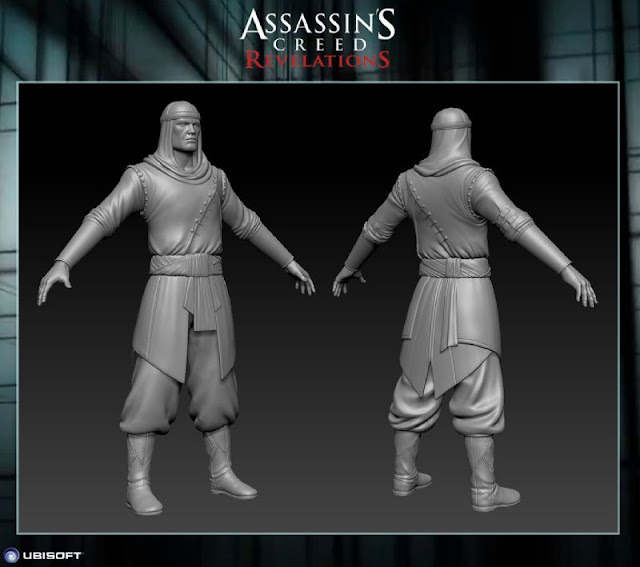
As you can see the face is much more detailed than the rest of his body. Models in general are more detailed than surrounding areas.
After the details are there - one needs to give the some textures. This is an image showing the change from untextured to textured.

A similar process happens for all environments in a game.
When the models are finished they have to be animated. This model of Copernicus would have running and fighting animations. His cape would be animated to look like it behaved like cloth. Much of computer graphics improvement in games over the years can be attributed to good middleware - and example of which is companies specialising ing making cloth animations for gaming studios. Another is SpeedTree - which makes algorithms for making trees.
Wireframe models can get incredibly complex. Have a look at this city from Assassin's Creed.

Because of the huge complexity of these models it is impossible for computers to include all that detail at the same time. Buildings that are further away lack much of the detail that the close buildings have. When you run towards the buildings details pop- into existence. Normally you don't notice this. People for some reason don't notice these kinds of change very well. But at other times it becomes very noticeable. Then you would say that the game suffers from "pop- ins".
Lighting is a very interesting area currently under development. Light comes from more than bulbs - it is also reflected, scatters unevenly, hits dust particles in the sun - is emitted from warm objects and can also scatter in translucent things like clouds or jade. To see what I mean take a look at the development video beneath.
I hope this has helped you gain a rudimentary understanding of video game graphics. Now go explore for yourself!
It was a privilege following the development of computer graphics in the way I did. The developments to graphics lead me to appreciate true nature in a new way. I didn't think about the detail of the geometry of real buildings before it was talked about in videogames - and certainly not the peculiar way light hits you skin - penetrates and spreads in your body, and reflects back. That's how you can see someone blushing - you see the rush of blood under the skin.
The beauty of modern computer games can parallel that of reality. But the complexity of modern technology hides the inner beauty of their worlds composition very well. What i will do today Is try to reveal how the graphical aspects of these computer worlds are put together. This knowledge will hopefully help you to appreciate not only the marvel that is a modern computer- game - but also some of the superb phenomenal of the real world.
Actually I hate to say "the real world" - which implies that digital landscapes are somehow un- real. They are not; they are as real as the natural world. The difference is that the digital world is made- real, or realised, in a computer. And compared to nature is harder to visit, simpler and intelligently designed.
One might say that its ontology sits on top of the ontology of the outside world. Today we will dig into the depths of this digital layer - but not so far down that we get into real physics.
This image is from Dear Esther. In it you spend your time walking around accompanied by the voice of your own character. This image consists of a few things. A skybox - which is the edge the geometry. A wireframe that makes up the geometry consisting of thousands of triangles named polygons. On top of that is a flat surface, which is ten textured. Textures are images on top of the geometry. The grass is not 3D - but only a 2D surface spread around the landscape. Surfaces are lighted and shadows are calculated.
It can be difficult to understand just from looking at a finished model what goes into it. Let's have a look under the hood.
 |
| Dear Esther |
This is a wireframe model of a games environment. You can just about make out a door and some fountain or something in the middle. This is what a video game looks like in it's simplest form. The triangles you see are polygons. The form the shape of the geometry. The polygon count - how many there are at the screen at the same time - has gone up immensely over the years. Old models used to look blocky - now things are generally quite good looking.

This grid is then overlayed with a grey plane. This plane can then be lighted and shaded. This is a picture of an enemy model from the game Assassin's Creed: Revelations.


As you can see the face is much more detailed than the rest of his body. Models in general are more detailed than surrounding areas.
After the details are there - one needs to give the some textures. This is an image showing the change from untextured to textured.

A similar process happens for all environments in a game.
When the models are finished they have to be animated. This model of Copernicus would have running and fighting animations. His cape would be animated to look like it behaved like cloth. Much of computer graphics improvement in games over the years can be attributed to good middleware - and example of which is companies specialising ing making cloth animations for gaming studios. Another is SpeedTree - which makes algorithms for making trees.
Wireframe models can get incredibly complex. Have a look at this city from Assassin's Creed.

Because of the huge complexity of these models it is impossible for computers to include all that detail at the same time. Buildings that are further away lack much of the detail that the close buildings have. When you run towards the buildings details pop- into existence. Normally you don't notice this. People for some reason don't notice these kinds of change very well. But at other times it becomes very noticeable. Then you would say that the game suffers from "pop- ins".
Lighting is a very interesting area currently under development. Light comes from more than bulbs - it is also reflected, scatters unevenly, hits dust particles in the sun - is emitted from warm objects and can also scatter in translucent things like clouds or jade. To see what I mean take a look at the development video beneath.
I hope this has helped you gain a rudimentary understanding of video game graphics. Now go explore for yourself!
Subscribe to:
Posts (Atom)